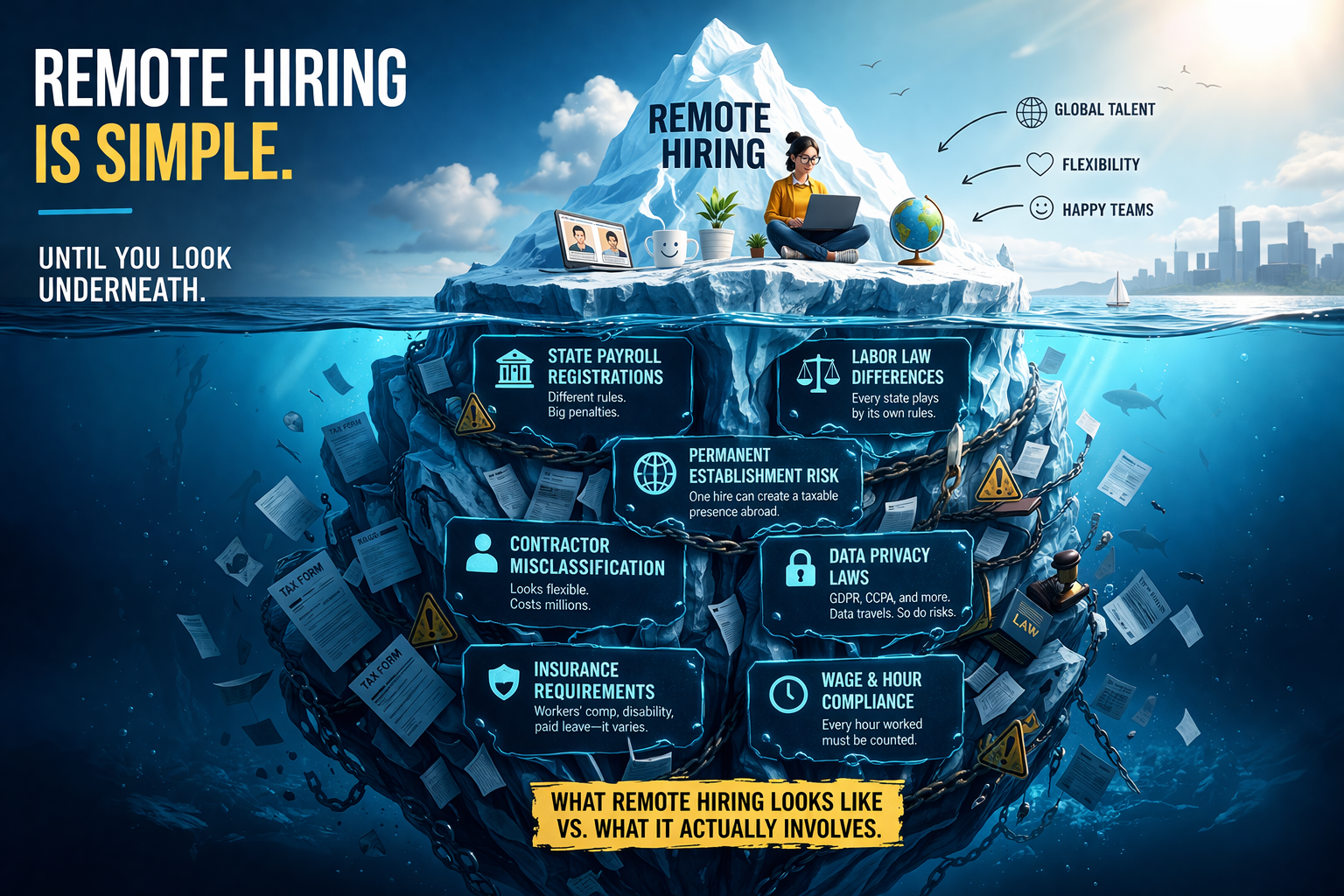
Remote work has been sold as a kind of superpower for startups. You can hire the best talent anywhere, scale quickly without geographic constraints, and build a team that’s always on. On the surface, it feels like one of the few truly unfair advantages available to early-stage companies.
But what often gets lost in that narrative is a quieter truth: every remote hire introduces a new set of legal, tax, and regulatory obligations. Not hypothetically but immediately. And unlike product decisions or go-to-market strategy, these aren’t areas where you can afford to “figure it out later.”
The real risk with remote compliance isn’t that it’s impossible to manage. It’s that it’s easy to ignore until it becomes a real headache that is expensive, distracting, and very public.
When a startup hires its first employee outside its home state, it rarely feels like a meaningful operational shift. It’s just one person. The offer letter goes out, the employee starts, and payroll runs as usual. But from a compliance standpoint, something fundamental has changed: the company is now operating, in a legal sense, in another jurisdiction.
That shift brings obligations that don’t announce themselves loudly. You may need to register with the new state’s tax authority, begin withholding the correct state income taxes, and contribute to that state’s unemployment insurance system. None of this is particularly complex in isolation, but it’s also not automatic. Many founders assume their payroll provider handles these details end-to-end, only to discover months later that registrations were never completed. The result is often a letter from a state agency outlining back taxes owed, along with penalties and interest that could have been avoided with a bit of upfront attention.
The complexity deepens when you hire in states with stricter labor laws. California is the most commonly cited example, but it’s not unique. Its rules around overtime, meal breaks, and employee classification are far more stringent than in many other states. A role that qualifies as exempt elsewhere may not meet the threshold in California, even if the title and salary seem comparable. Startups often discover this only after the fact i.e. when an employee raises a concern or, worse, files a claim. What seemed like a straightforward hiring decision can quickly turn into retroactive overtime payments, penalties, and legal exposure.
If domestic compliance is easy to underestimate, international hiring is where things become genuinely non-intuitive. Founders are often drawn to the idea of hiring a single employee abroad—an engineer in Canada, a salesperson in the UK, a contractor in India—because it feels lightweight. There’s no office, no formal entity, just one person contributing remotely.
But tax authorities don’t necessarily see it that way. In many cases, that single employee can create what’s known as a permanent establishment (a taxable presence in another country). The threshold for this isn’t always obvious. It can depend on the nature of the employee’s work, their level of authority, and whether they are effectively conducting business on behalf of the company within that country. A salesperson negotiating or signing contracts locally, for instance, can be enough to trigger it.
Once that line is crossed, the implications are significant. The company may be required to pay corporate taxes in that country, comply with local reporting requirements, and navigate a set of rules it never anticipated. What began as a cost-saving hiring decision can evolve into a multi-jurisdictional tax situation that requires specialized legal and accounting support to unwind or manage.
Even when companies try to stay flexible by hiring contractors instead of employees, they often walk into another well-known compliance trap: misclassification. The distinction between an independent contractor and an employee isn’t determined by what the contract says, it’s determined by how the relationship functions in practice. If someone is working full-time hours, reporting to a manager, and operating as part of the core team, regulators are unlikely to view them as independent, regardless of how they were onboarded.
This risk tends to accumulate quietly. A contractor starts with a clearly defined project, then stays on longer, takes on more responsibility, and gradually becomes indistinguishable from an employee. It’s only when the relationship ends, or when the individual raises a concern, that the classification is scrutinized. By then, the exposure includes back taxes, unpaid benefits, and potential penalties. In some jurisdictions, it can even open the door to broader claims if others were classified similarly.
Layered on top of all this is the reality that remote work fundamentally changes how data is accessed and handled. Employees are no longer operating within a controlled office environment; they’re logging in from personal devices, home networks, and sometimes across borders. For startups handling customer data, especially if they have users in regions with strict privacy frameworks, this introduces another dimension of compliance risk. It’s not just about having a privacy policy in place, but about ensuring that access controls, data storage practices, and employee behavior align with regulatory expectations.
Wage and hour compliance presents yet another subtle challenge. For hourly employees, the requirement to track and compensate all time worked doesn’t disappear in a remote setting, it becomes harder to enforce. An employee who logs off at the end of the day but continues answering messages or handling tasks after hours is still working. Without clear policies and reliable tracking, those extra hours go unrecorded until they surface later as a wage claim. By then, what felt like minor, informal flexibility can translate into measurable financial liability.
What makes all of these risks particularly challenging is that they rarely surface during day-to-day operations. The team is focused on building, shipping, and growing. Nothing appears broken. Compliance, in that sense, is invisible—until an external event forces it into view.
That event is often fundraising.
During due diligence, investors and their counsel will look closely at employment practices, tax registrations, and any potential liabilities tied to your workforce. Questions that may never have been asked internally, Are all workers properly classified? Are you registered in every state where you have employees? Have you created tax exposure internationally? suddenly become central. Issues that might have been manageable early on can delay a deal, reduce valuation, or require costly remediation under tight timelines.
This is where compliance debt behaves very much like financial debt. It compounds quietly, accrues interest in the form of penalties and risk, and tends to come due at the least convenient moment.
None of this is to suggest that remote hiring is inherently problematic. It’s not. But it does require a shift in mindset. Compliance can’t be treated as an afterthought or something that tools will handle automatically. It needs ownership, even in a small organization, and it needs to be built into the way hiring decisions are made.
The most effective startups approach this pragmatically. They develop a simple but consistent process for evaluating new hiring locations before extending an offer. They make intentional decisions about whether to hire directly or use intermediaries like employers of record when operating internationally. They revisit contractor relationships periodically to ensure they still hold up under scrutiny. And, perhaps most importantly, they recognize that while software can streamline compliance, it doesn’t replace accountability.
Remote work didn’t eliminate borders—it just made them easier to overlook. The companies that navigate this well aren’t the ones that avoid complexity altogether; they’re the ones that acknowledge it early and build systems that scale with it.
Ignore it, and compliance will eventually interrupt your momentum.
Plan for it, and it becomes just another part of running a disciplined, resilient company.